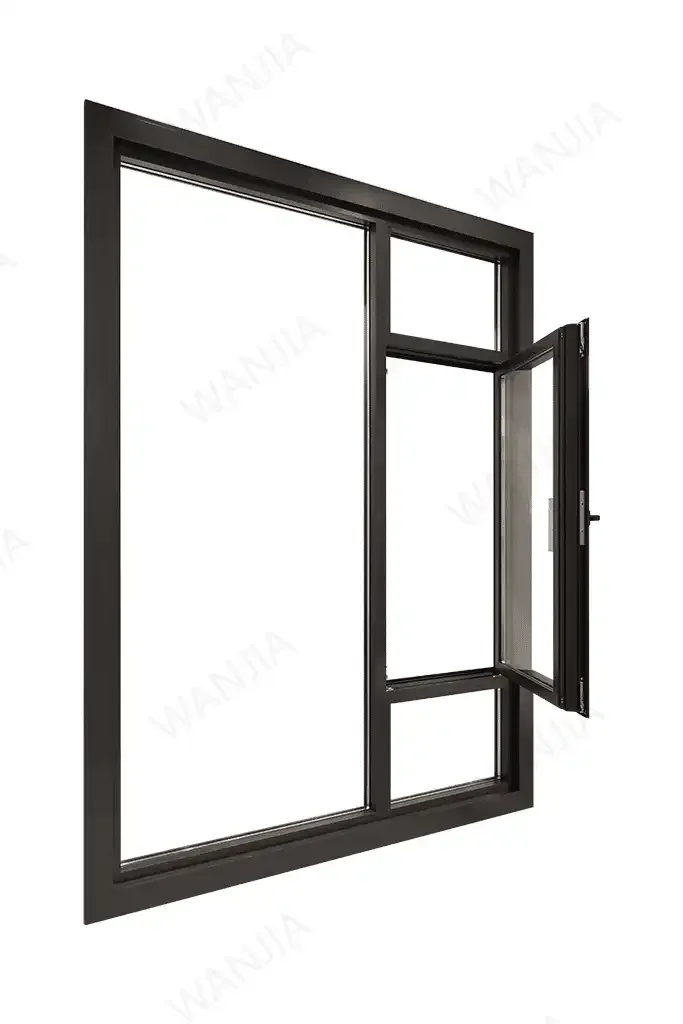
A tilt and turn window is a European style window with a single handle that controls two opening positions. Turn the handle one way and the top of the sash tilts inward a few inches for draft free ventilation. Turn it another way and the whole sash swings inward like a door, giving you full access to the opening and both sides of the glass. This dual action comes from a multi point locking system built into the frame, not from a simple hinge.
Builders and homeowners in North America often ask what is a tilt and turn window when they first see one in a showroom or on a project plan. The answer is simple. It is a window that solves several practical problems at once: how to air out a room without letting in rain, how to clean upper floor windows from inside, and how to secure a window that still opens wide. WANJIA Hiseng manufactures aluminum clad wood and aluminum tilt and turn windows for export to North America, using European hardware from ROTO, SIEGENIA, and CMECH.
How Do Tilt and Turn Windows Work?
The operating mechanism is easier to understand when you look at the hardware. A tilt and turn window uses a set of locking pins around the sash and a multi point gear driven by one handle. The handle has four positions: closed, tilt, turn, and sometimes a fourth position for micro ventilation depending on the hardware brand.
In the closed position, the pins engage the frame all the way around. The sash is pulled tight against the weatherstripping, which helps with air sealing and sound reduction. When you rotate the handle 90 degrees, the bottom pins stay engaged while the top pins release. The sash tilts inward at the top, usually about 4 to 6 inches. This is the tilt position. Air flows in through the top gap while the bottom of the sash stays locked to the frame. Rain runs down the outside glass and does not enter the room.
Rotate the handle 180 degrees from closed and all the pins release except the side hinges. The sash swings inward like a door, pivoting on the side hinges. This is the turn position. You can open it fully to clean the exterior glass from inside, or use it as an emergency escape route if the window is large enough. The same handle controls both functions, so there is no separate latch or crank.
Key Benefits of Tilt and Turn Windows
Ventilation Without Compromise
The tilt position is the main reason many people choose this window type. You can leave the window tilted during light rain or overnight without worrying about water getting in. The inward tilt directs air upward and into the room, which reduces direct drafts on people sitting nearby. This makes tilt and turn windows a good choice for bedrooms, living rooms, and home offices where you want fresh air but not a strong breeze.
Security in Both Positions
Because the sash locks at multiple points around the frame, a tilt and turn window is harder to force open than a window with a single latch. In the tilt position, the bottom pins remain engaged, so the window cannot be pushed open from outside. The opening is only a few inches wide, not enough for a person to pass through. This lets you ventilate a ground floor room without creating an easy entry point. The multi point locking system is standard on the aluminum clad wood tilt and turn windows from WANJIA Hiseng.
Easy Cleaning from Inside
Cleaning a second story window usually means a ladder or a long handled squeegee. With a tilt and turn window, you turn the handle to the full open position and swing the sash inward. Both sides of the glass are now reachable from inside the room. This is a major advantage for apartment buildings, townhouses, and any home with windows above the ground floor. It also makes the window a practical choice for people who do not want to hire a window cleaning service.
Thermal Performance
Tilt and turn windows can be built with double or triple glazing, Low E coatings, and thermally broken frames. The aluminum 91 series tilt and turn window from WANJIA Hiseng uses a thermal break and triple glazing to reach a Uw value of 1.4 W/m²K. That level of insulation helps reduce heat loss in winter and heat gain in summer. The multi point locking system also pulls the sash tight against the seals, which reduces air leakage compared to windows that rely on a single latch. For projects that target low energy use, these windows are worth considering. You can read more about low U value configurations on our passive house windows guide.
Materials and Hardware Options
WANJIA Hiseng offers two main material choices for tilt and turn windows: aluminum clad wood and all aluminum. Each has its own strengths depending on the project.
Aluminum Clad Wood Tilt and Turn Windows
This construction puts solid wood on the interior and aluminum on the exterior. The wood gives the window a warm, natural look inside the room. The aluminum cladding protects the wood from rain, sun, and temperature swings. You get the beauty of wood without the maintenance of an all wood window. The aluminum exterior can be powder coated, anodized, or finished with a wood grain texture. Hardware comes from ROTO, SIEGENIA, or CMECH, all European brands known for smooth operation and long service life. Glazing options include double, triple, and Low E glass. See the full product details on our aluminum clad wood tilt and turn windows page.
Aluminum Tilt and Turn Windows
For a slimmer frame and a more contemporary look, the aluminum series is a strong option. The 91 series thermal break tilt and turn window uses 6060-T66 aluminum with a 1.8 mm wall thickness and local reinforcement up to 2.0 mm. It is available with triple glazing (5+16A+5+16A+5) and achieves a Uw of 1.4 W/m²K and Rw of 37 dB. The 91 series is ENERGY STAR certification-backed, and the tilt and turn window also holds NFRC and CSA certificates. The 70 series offers a Uw of 2.0 W/m²K and Rw of 30 dB with glass up to 5+27A+5. For very large openings, the K80 automatic tilt and turn window adds a smart control panel and delivers the same Uw 1.4 and Rw 37 dB performance. You can compare models on our aluminium tilt and turn windows page.
| Series | Frame Material | Uw | Rw | Certifications |
|---|---|---|---|---|
| 91 series | Thermal break aluminum | 1.4 W/m²K | 37 dB | ENERGY STAR, NFRC, CSA |
| 70 series | Thermal break aluminum | 2.0 W/m²K | 30 dB | NFRC, CSA |
| K80 automatic | Thermal break aluminum | 1.4 W/m²K | 37 dB | NFRC, CSA |
Where Tilt and Turn Windows Fit Best
Tilt and turn windows work well in many building types, but they are especially useful in a few situations.
In multi story homes and apartments, the inward opening turn function makes cleaning safe and simple. You do not need to lean out or use a ladder. The tilt function allows ventilation even on upper floors where wind can be strong. Because the window opens inward, it does not interfere with balconies or exterior walkways.
In cold climates, the multi point locking and triple glazing options help keep heat inside. The tilt position lets you air out a room without losing as much heat as opening a window fully. In warm climates, the same tilt position provides continuous airflow without letting in insects if you add a screen. Screens are available as an option on WANJIA Hiseng windows.
For commercial projects such as offices, schools, and healthcare buildings, tilt and turn windows offer controlled ventilation and easy maintenance. The hardware is durable enough for frequent use, and the inward opening design means the exterior facade stays clean and uncluttered.
What to Consider Before Buying
Before you specify tilt and turn windows for a project, think about a few practical points.
First, the window opens inward. This means you need clear space inside the room for the sash to swing. Furniture, curtains, or shelves placed too close to the window will block the turn function. The tilt function still works, but you lose the full opening benefit. Plan the interior layout accordingly.
Second, screens require a specific design. A standard exterior screen will not work with an inward opening sash. WANJIA Hiseng offers integrated screen systems that fit the frame and allow the tilt and turn operation. Make sure to include screens in your order if you need insect protection.
Third, hardware quality matters more than with a simple casement window. The multi point locking system and the hinge mechanism carry the full weight of the sash in both positions. Cheaper hardware can sag or bind over time. WANJIA Hiseng uses ROTO, SIEGENIA, and CMECH hardware on the aluminum clad wood series, and the aluminum series is built with the same standard of durability.
Fourth, installation requires attention to square and level. The frame must be installed plumb and square for the multi point locking pins to engage correctly. WANJIA Hiseng provides installation videos and guidance after delivery, and the technical team can assist remotely until the project is finished. We do not offer on site installation, but the documentation is detailed enough for a competent installer.
Finally, lead time and warranty are important for project planning. Production usually takes 25-30 business days depending on the design, materials, and order volume. Warranty depends on the specific product and contract terms. If you need a quote, send your project details and you will receive a response within 3 hours.
Frequently Asked Questions About Tilt and Turn Windows
How do tilt and turn windows work?
One handle controls two opening modes. Turn it 90 degrees and the top of the sash tilts inward for ventilation while the bottom stays locked. Turn it 180 degrees and the sash swings inward on side hinges like a door. The multi point locking system engages pins around the frame in both positions, which keeps the window secure and the seal tight.
Are tilt and turn windows more expensive than regular windows?
The hardware is more complex than a simple casement or sliding window, so the upfront cost is often higher. However, the dual function replaces two window types in many applications, and the multi point locking and thermal performance can reduce long term energy and maintenance costs. For a specific price, request a quote with your project details.
Can tilt and turn windows be used for egress?
Yes, if the window meets the local building code for egress size and operation. The turn position opens the full sash inward, which can serve as an emergency escape route. Check with your local code official for minimum clear opening dimensions. WANJIA Hiseng can build windows to your specified sizes.